

VISION
The Filtration Skyscraper is a highly modularized prefabricated waste-management and waste-to-energy power plant megastructure that contains several Material Recovery Facilities (MRF) and Water Treatment Plants (WTP) to recycle the floating garbage continent and clean seawater at all levels from the different oceans across the world. The innovation serves to be self-sustaining and helps to resolve the world energy crisis in this coming century.


RAM PUMP
A hydraulic ram pump has only two moving parts:A mostly weight loaded waste valve, sometimes known as the clack valve and a delivery check valve, which makes the pump operation reliable and easy to maintain.
Other non-moving parts are the drive pipe which supplying water from an elevated source and a delivery pipe, taking a portion of the water that comes through the drive pipe to an elevation higher than the original water source.

WASTE MANAGEMENT
80 percent of plastic in the ocean is estimated to come from land-based sources, with the remaining 20 percent coming from boats and other marine sources. These percentages vary by region, however. A 2018 study found that synthetic fishing nets made up nearly half the mass of the Great Pacific garbage patch, largely due to ocean current dynamics and increased fishing activity in the Pacific Ocean." An open access study published in 2022 concluded that 75% up to 86% of the plastic pollution is from fishing and agriculture with most identified emissions originating from Japan, China, South Korea, and the US.


WASTE TO ENERGY
Waste-to-Energy (WTE) facilities are specialized industrial plants designed to convert solid waste, typically municipal solid waste (MSW), into energy, primarily in the form of electricity and heat. These facilities incorporate various architectural and engineering features to ensure efficient and environmentally responsible waste management.


TYPES OF OFFSHORE OIL RIG
The effects of greater water depths, storms, wave action, and uncertain exploratory data all greatly increase the financial risks. The exploratory wells must be drilled, and a reserve potential established that could justify these costs. These exploratory wells seek to establish new reservoir locations and sizes. Once drilled and evaluated, the exploratory well is most often plugged and abandoned. This results in the use of marine rigs for offshore drilling. The development wells are usually drilled from fixed platforms specially designed to exploit the reserves of the reservoir. The platform is also used for production facilities after all drilling operations are complete.



1. EXISTING ABANDONED OIL PLATFORM
About 2978 decommissioned oil platforms rotting in waters all over the globe could get a new sense of purpose.
2. DEMOLISH THE OIL PLATFORM
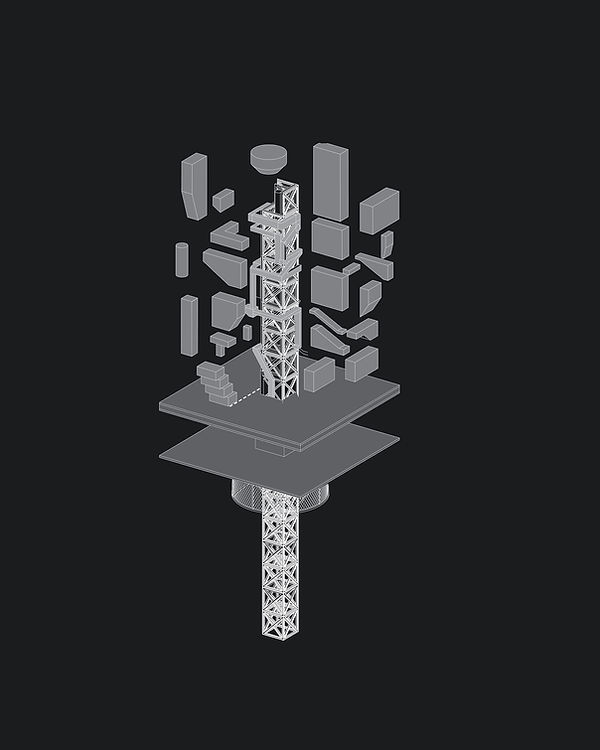
Partially Remove or recycle the extra parts of the abandoned oil platform. Keep the existing main structure, such as the ductor guide frame, foundation legs, cellar deck, Spider deck, and main structural components.
3. ATTACH PREFABRICATED RECYCLE COMPONENTS
Prefabricated components can be attached to the guide frame based on the order of the recycling process. Vertical Mechanical Biological Treatment Technologies invented this integrated system. It combines several MRF and WPT with waste-to-energy power plants.
4. VERTICAL RECYCLE MACHINE
The waste-management facility acts to densify, separate, and clean the output streams. It also hydro-crushes and dissolves biodegradable organics in solution to make them suitable for anaerobic digestion.
5. PTFE COATE GLASS FIBER REINFORCED FACADE
PTFE-coated, glass fiber-reinforced sun shade around a slender 800-meter tower, blocking direct sun and moisture exposure for facilities from all four sides. The inside of the facade has a PV solar panel to gain energy if needed.
6. OPERATABLE FACADE
It allows the dysfunctional recycling pod to be replaced without touching other components. It also can control heat exchange and reduce vertex shedding from the high-velocity airflow, even though the garbage patch is usually located in the windless zone.
FEATURES
The Great Pacific Garbage Patch is a collection of marine debris in the North Pacific Ocean. Also known as the Pacific trash vortex, the garbage patch is actually two distinct collections of debris bounded by the massive North Pacific Subtropical Gyre.


